Showing posts with label C.S. Lewis. Show all posts

Tuesday, October 2, 2018

Book Reviews: 11 - 15 of 2018

The Queen of Spades is a classic Russian short story. A young man learns of a woman who was told the perfect combination of cards to play to make her fortune and save her from ruin. The woman is now old, so the young man starts making overtures of love to the old woman's companion. Once he gains access into the house, he surprises the old woman and tries to threaten her into telling him the combination. Much to his dismay, the old woman dies from shock and he is left with guilt and no winning cards. After paying his respects at her funeral, the old woman's ghost comes to him in the night and tells him the cards and how to use them as well as making him agree to the terms that were handed down. The very next night he tempts fate and tries to play the cards to a rather interesting outcome.

I am surprised at how much I enjoyed this book. It's a quick story, but it really is an interesting idea and it really could apply to any period in history. This was my first experience reading Pushkin and it definitely made me want to read more. I give this book 4 out of 5 stars.

The Portable Dorothy Parker is a great collection of her work. The book is made up of various short stories and poems as well as a few articles. The overall tone was snarky and poignant. I really loved The Big Blonde - I think that was the most touching story in the bunch, interesting that it is based off her own experience. Miss Parker is able to look at the women of her time and show them in a sarcastic way that they probably didn't see themselves. The poetry is admittedly of a style our time hasn't really been taught to appreciate. Also the poems were mostly about how death would be, so not something everyone can relate to but an interesting window into that way of thinking. As this is a short story and poem collection, you can just keep listening through anything you don't love and something new will come up soon. It's worth the read for sure. I give this book 4 out of 5 stars.

State of Wonder is the story of Marina Singh, a medical doctor turned pharmaceutical worker who finds herself on an adventure in the Amazonian rain forest. The company Marina works for has financed a new miracle fertility drug and they need someone to go down to Brazil and check the progress so they have a timeline for a return on their investment. Marina's lab partner went first, but when the company receives word that he died of a fever they ask Marina to go and find out what happened. Marina finds herself in a remote Amazonian village with her old college professor and a tribes-people whose women are able to get pregnant into their 70s. Marina assists in the research while trying to learn more about her deceased partner as well as helping the local tribes with medical complaints so the other researchers can complete their work. Eventually Marina learns to true point of the research and what it can mean for the rest of the world before a pretty interesting twist at the end.

I really enjoyed this book. The idea is pretty crazy - a fertility drug that could let women of any age have a child - yet at the same time feels fairly plausible in our modern world. The book is very well written and I was able to just focus on the plot unfolding. I'll confess that I wanted to read this book after Liz Gilbert's mention of it in Big Magic - I had to see what this story was that the two authors were both inspired by. I was much happier with this book than the other Ann Patchett I read a few years ago. I definitely can recommend this one though - I constantly wanted to know what would happen next.  I give this book 4 out of 5 stars.
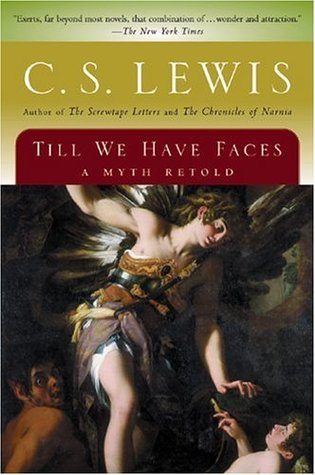
Til We Have Faces is a retelling of the myth of Cupid and Psyche. I was intrigued about this book when I found out C.S. Lewis felt this was his best work. The book gives a different take on the myth we are taught, giving the whole story through the eyes of one of her sisters. In this tale the oldest sister loves and raises Psyche after her mother dies. As Psyche gets older, her beauty grows to the extent that the people in her kingdom believe that she is a God. Eventually the town decides to sacrifice her in hopes of appeasing their God and removing their famine and other hardships. They chain her up on a mountain and leave her for the God, assuming she will soon be dead and not worry about her any further. Her sister is stricken by the loss of her favorite sister, so she goes to collect Psyche's remains for a proper burial only to discover that her body is not there. Psyche appears and explains that she is now the wife of a God, but she does not know which one because she is forbidden to look at him. Her sister thinks Psyche is crazy and comes up with a plan to help her see "the truth". She brings an oil lamp the next time she visits and makes Psyche swear she will look at the God, thinking this will show that the God is a monster or not a god at all. Things don't turn out how she anticipates and she has to live with this for the rest of her life.

Overall this was an interesting idea and it definitely humanizes the classic myth. The original story has both sisters jealous of Psyche's husband so they maliciously conspire to wreck things, and I can appreciate this telling much better. This method feels more natural - that the motives are all in the best interest of the victim but that they go horribly wrong. I think this version makes the story more palette-able even for a reader that is not interested in Greek mythology. I give this book 4 out of 5 stars.

Secondhand Time should be required reading. The book is made up of interviews with various Russians who lived through the Soviet regime, covering everything from the revolution to perestroika to the modern switch to capitalism. There are those who miss Stalin, those who hate him, and those who worked with him. There are true Russians as well as those from other Soviet states like Azerbaijan, Ukraine, Georgia, and many more. Alexievich interviews the young and the old alike, which comes across as the indoctrinated and the disillusioned. This book shows the true mix of feelings on the Soviets and opens up about things I never learned about before I read this book. Some of the tragedies people endured were truly heartbreaking, yet they still continue on in a stoic and accepting manner. If you have any interest in the state of modern Russia and how its recent history has brought it to where it is now, you should read this book. It was excellent. I give this book 5 out of 5 stars.

Friday, June 26, 2015

Book Review: Mere Christianity by C. S. Lewis

This book has always been on my "to read eventually" list, but I finally picked it up for a book club I've joined. This was our book for May, and I am really glad it gave me an excuse to read it.

Mere Christianity was actually a BBC broadcast series by C. S. Lewis done from 1942 to 1944, separated by 3 broadcasts: The Case For Christianity, Christian Behavior, and Beyond Personality. The book is the result of C.S. Lewis' in depth studies into Christianity over the years, and the basic premise is to define Christianity as a whole. No matter what "theology" of Christianity you choose, this book sets down the ground rules that every follower of Christ believes. It's very interesting that he removes any specific religion's beliefs from the argument - everything listed in this book is defined by the teachings of Christ in the bible, so there really is no gray area on these terms. The book examines such points as faith, hope, charity, forgiveness, chastity, and "Be thou perfect", among other things.

This book was just incredible. C.S. Lewis is able to explain things in such a way that it really made me look at certain aspects of my own beliefs in a new light. I particularly loved how he explained that you must choose a religion within Christianity:
I hope no reader will suppose that 'mere' Christianity is here put forward as an alternative to the creeds of the existing communions - as if a man could adopt in it a preference to Congregationalism or Greek Orthodoxy or anything else. It is more like a hall out of which doors open into several rooms. If I can bring anyone into that hall I shall have done what I attempted. But it is in the rooms, not in the hall, that there are fires and chairs and meals. The hall is a place to wait in, a place from which to try the various other doors, not a place to live in. For that purpose the worst of the rooms (whichever that may be) is, I think, preferable. It is true that some people may find they have to wait in the hall for a considerable time, while others feel certain almost at once which door they must knock at. I do not know why there is a difference, but I am sure God keeps no one waiting unless He sees that it is good for him to wait. When you do get into your room you will find that the long wait has done you some kind of good which you would not have had other wise. But you must regard it as waiting, not as camping. You must keep on praying for light: and, of course, even in the hall, you must begin trying to obey the rules which are common to the whole house. And above all you must be asking which door is the true one; not which pleases you best by its paint and panelling. In plain language, the question should never be: 'Do I like that kind of service?' but 'Are these doctrines true: Is holiness here? Does my conscience move me towards this? Is my reluctance to knock at this door due to my pride, or my mere taste, or my personal dislike of this particular door-keeper?' When you have reached your own room, be kind to those who have chosen different doors and to those who are still in the hall. If they are wrong they need your prayers all the more; and if they are your enemies, then you are under orders to pray for them. That is one of the rules common to the whole house.
I also really loved the chapter about forgiveness. He relates questions he often received from skeptics at the time he wrote this (during and after World War II) about how it isn't right to just forgive the Nazis everything and move on. He examines the law of "Love thy neighbor as thyself," and breaks it down to realize that to love one as oneself doesn't mean that you have to like them or think them always right since we do not always like ourselves or think that we are a "good person"l. We forgive ourselves every single day and we still love ourselves in spite of our flaws. To love our neighbor as yourself, we simply need to hope that they will become better than they are, just as we hope for ourselves.

One chapter in particular really stuck with me (so much so that I copied the entire thing for future quotes) - the chapter called Counting the Cost. In this chapter, Lewis explains that while we may only want to let God help us to become better at certain things, he will not stop until we achieve perfection. He relates a wonderful quote from George MacDonald that really stuck out to me:
Imagine yourself as a living house. God comes in to rebuild that house. At first, perhaps, you can understand what He is doing. He is getting the drains right and stopping the leaks in the roof and so on: you knew that those jobs needed doings and so you are not surprised. But presently he starts knocking the house about in a way that hurts abominably and does not seem to make sense. What on earth is He up to? The explanation is that He is building quite a different house from the one you thought of - throwing out a new wing here, putting on an extra floor there, running up towers, making courtyards. You thought you were going to be made into a decent little cottage: but He is building a palace. He intends to come and live in it Himself.
As I'm sure you can tell by all the quotes, I absolutely loved this book. I look at my own faith in a whole new light now, and that is remarkable that a simple book like this could accomplish such a feat. I feel that I understand Christ and his teachings a little better, and even feel a little more enlightened about what I have agreed to by following Him. Even if you are not a Christian yourself, this is a very educational and unbiased view of Christianity as a whole. If you've ever wanted to understand the basics, this is the book for you. Likewise, if you want to gain a better understanding about the principles upon which all different Christian religions are based upon, this is the book for you. Reading it will inspire you to be a better Christian while giving you the building blocks to begin your efforts. I give this book 5 out of 5 stars.