Showing posts with label buddhism. Show all posts

Wednesday, May 20, 2015

Book Review: The Trauma of Everyday Life by Mark Epstein, M.D.

I've had this book on my list to read ever since hearing it praised in 10 % Happier. I've recently been going through quite a personal ordeal, so it seemed a good time to step back into thinking about Buddhism in hopes it could give me insight into my own situation. I figured if it helped Dan Harris so much, it certainly couldn't hurt me.

The Trauma of Everyday Life is a wonderful step into the notion that combines psychiatry and Buddhism. Mark Epstein is a psychiatrist known for using Buddhist practices in treating his patients, and this book served as a good overview of how the two intertwine. Epstein gives examples of different "traumas" some of his patients experienced, and then references one of the Buddha's teachings that applied to that circumstance. There is quite a bit of retelling of stories from the Buddha's life and what they taught the people of his time, but Epstein always ties it back into our modern lives. The biggest focus is the concept of, "The only way out is through." It is only by allowing ourselves to experience our emotions, no matter how unpleasant, that we can overcome them.

This book is full of really wonderful quotes, several of which I wrote down to help me remember. I thought they would be worth sharing, so here goes:
"Enlightenment does not mean getting rid of anything. It means changing one's frame of reference so that all things become enlightening."
"When we stop distancing ourselves from the pain in the world, our own or others, we create the possibility of a new experience, one that often surprises because of how much joy, connection, or relief it yields. Destruction may continue, but humanity shines through." 
"Awakening does not mean a change in difficulty, it means a change in how those difficulties are met."
I highly enjoyed this book. The more I delve into Buddhism, the more respect I have for the concepts it teaches. I am a much more confident person having learned just what I have in the past 6 months, and this book certainly helped me on that path. I would caution that this probably wouldn't be the best book for a complete newcomer to Buddhism - maybe read one of the other books I've read this year first - but this will absolutely help to show how practical a Buddhist frame of mind can be when it comes to our emotional lives. I give this book 4 out of 5 stars.

Tuesday, February 24, 2015

Book Review: 10% Happier by Dan Harris

This was another book I just picked up because it was in the Buddhism section and came on audio cd, lol. I knew nothing about who Dan Harris is (I never watch news related shows ... ever), but just by reading the quick description I decided it would be worth a read. Again, this turned out to be a wonderful strategy, because I LOVED this book. What you must know before getting into this synopsis is that ... Dan Harris is kind of an asshole. I don't mean that as anything personal against him (in fact he mentions at the beginning of the book that he wanted the title to be The Voice In My Head Is An Asshole). I'm glad I hadn't heard of him before this book, because I bet that his interviewing style would have made me think, "Oh, that guy is a total jerk. I don't care what he has to say." But the fact that this guy is a total cynical jerk ended up being what made this book so wonderful.

10% Happier is the story of Dan Harris, a tv news reporter who stumbled upon Buddhism in a very unusual way. After working his way up the system for a while, he landed a job as a young correspondent for ABC news working under Peter Jennings. After he proved himself as a reporter during 9-11 and then on the ground in Iraq and Afghanistan during the war, Peter Jennings designated Dan as the "spirituality correspondent", meaning he had to report on anything remotely spiritual that became news. At first, Dan hated this idea - he was mostly an atheist and he had no interest in all these "religious wackos" he would be reporting on. Then Dan had an unfortunate occurrence - he had a panic attack on the air. You can even watch the actual event on youtube. He didn't understand what happened or why, so he went through various doctors and therapists until discovering that his highly competitive live style combined with pent up emotions from his time in active war zones eventually falling into drug use put him in a very unstable physical and mental state. All these things were causing unacknowledged depression, which the ups and downs of drugs caused to manifest itself as an actual attack. After delving into all of his personal issues, he decided to use his position as a spirituality correspondent to his advantage and see what all these people had going for them to see if anything "worked for him." He went from being friends with big names in Evangelical Christianity (this was the early 2000s, when these groups were very news worthy) to having a friend recommend a book by Eckhart Tolle. Dan read A New Earth with great interest, but was left hanging when it came to actual application of the ideas he liked. He just couldn't be ok with all the "metaphysical speak". So he interviewed Eckhart Tolle to try and get more answers - this just caused him more confusion when he found out that Tolle is such a kook. The idea of being happier by suppressing "the ego" though was exactly what Dan Harris liked. Dan went on to hang out with Deepak Chopra for a time, again feeling unfulfilled, but for the exact opposite reason: Tolle seemed genuine but insane while Chopra seemed logical but working on his marketing scheme. After these interesting interactions with famous men, Dan's wife recommended a psychiatrist named Mark Epstein and suddenly things really started to click.

Mark Epstein is a Harvard grad M.D. who combines the teachings of the Buddha with the teachings of Freud is treating mental health issues. Not only did his ideas make sense - they had clinical studies to prove their effectiveness. This is where Dan got the idea of trying meditation. Mark recommends Dan look into other people in his sphere of actual doctors who practice Buddhism without "being Buddhist" (meaning they do not worship the Buddha as a religion). This section of the book references lots of facts about meditation, but Dan also talks about his own personal application of each principle and how it helped him along the way. Dan eventually goes on a 10 day meditation retreat where he officially "sees the light" of what meditation can do for you. Not only does his day to day interaction and sense of self improve, he also sees benefits at work once he works out the kinks. The last part of the book breaks down all the principles he learns in general and then talks about how he applied them to the concept of "without losing my edge". He talks about the pitfalls of becoming "too zen" in a competitive workplace, but he does seem to find his stride in the end and becomes a lead male anchor on Good Morning America.

This book was probably the perfect things for me to read at this time in my life. I've always been interested in the concepts of meditation, even read other books explaining the particulars of the practice and benefits received, but I've just always been a little skeptical until now. Reading the teachings of Buddhist meditation as related threw a guy who is, as I said, a cynical jerk, really helped me see that it doesn't have to be a big song and dance to be a part of your life. You can just apply the basics and fit them into your life where you can. Basically anything is better than nothing when it comes to mindfulness and meditation. This is also an area that can always be improved upon in your life no matter how long you have practice or what levels you reach. I certainly am not one to start this seeking "enlightenment", but even the little things I have tried have made big differences that I can't necessarily give specifics on. I just add my small voice next to Dan Harris' that this can do great things in your life if you devote the time to cultivating the skill of taming your thoughts. I give this book a resounding 5 out of 5 stars (my first 5 star book of the year! Hooray!). I've talked about this book so much that now my husband and sister are reading it too :)

P.S. What was even better about listening to this as an audio book is that it was read by the author himself.


Tuesday, February 10, 2015

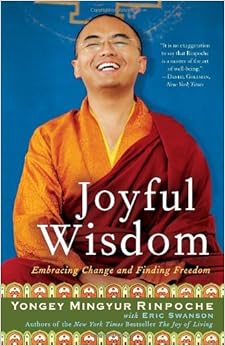
Book Review: Joyful Wisdom by Yongey Mingyur Rinpoche

It's kind of random how I came across this book - I had never heard of it before in spite of its best seller status. I know I've hinted before that I'm going through some big things in my personal life, so I'm sure this genre of book makes sense in that respect, but the biggest thing that lead me to this book is that my husband has really gotten into Buddhism lately and I wanted to be able to keep up with him so I searched my library catalog for "Buddhism" and perused the selection. I narrowed things down to what audiobooks were available (realistically I am driving so much that audiobooks are my best option to read right now), and this was first on the list that looked good to me. I'm glad to report that this blind picking method worked out well this time :)

Joyful Wisdom is what I like to summarize (loosely) as a practical guide to Buddhist meditation. The author is a monk from Nepal who travels around the world and teaches these basics. The book is broken down into 3 main sections: Principles, Experience, and Application. He covers the basic thought and history behind Buddhism first, moving onto what those basics mean in your own life, and then tells you how to apply these teachings to benefit your life. He uses examples not only from ancient Buddhist texts and teachings, but also from some of his modern students and what these specific techniques did for them. In the application section, he literally breaks down how to meditate on a specific Buddhist principle with instructions such as, "Assume the 7 point position. Clear your thoughts and think about a person who you feel gratitude for. Don't ponder on it for more than a few minutes." Very practical. Very precise. He even talks about how it's ok and even needed to take breaks, and how even if we feel like we are failing because we can't clear our mind, that's actually a good thing. Basically there is no failure - a nice notion to go into things with, really.

I have always been the type of person who was interested in meditation, but I just never found any explanations that made sense to me as to how to go about it. I'm not one who easily relates to metaphysical-speak like, "make friends with your fears." Seriously? What? How does one do that? The greatest thing I gained from this book is an explanation of the meditation process that actually made sense to me. It was also wonderful to learn that I am not alone or unprepared for this practice - in fact, most people feel similar to me when they can't get their head clear enough to focus on what they think they should. It's about clearing other thoughts out of the way so that you can focus on what surfaces during that clarity. If that thought bubbles up to the top, obviously it is at the forefront of your mind and needs your attention. I've never had such a rational sounding break down of meditation before. I fully believe that anyone who is interested in meditation, whether you've tried it and felt like you couldn't do it, or if you're like me and have never fully tried because it never made sense, this book is what you need. There is so much information in here that I'm sure it would help even a seasoned meditator.

I'm sure there is plenty more that I could say about this book, but just know that I give this book 4 out of 5 stars.