Showing posts with label classic. Show all posts

Wednesday, September 28, 2016

Book Review: Tess of the D'Urbervilles by Thomas Hardy

It's been quite a while since I posted any book reviews (mostly just because I've been lazy with writing them, not because I haven't been reading), and I am definitely jumping ahead in my queue of books read (I'm up to 41 this year so far, lol) but I recently finished this book and I had thoughts about it, so I decided I really should post the review. So hopefully you can expect to see more posts like this again :)
I put off reading this book for quite some time. I would always see it on the lists of "classics to read in your lifetime" yet every time I read the synopsis I just couldn't get on board with reading it. It sounded very much like the cliché dramatic romance style I avoid, yet one day I was finally willing to give it a try. And the book affected me.

Tess Durbeyfield is a lower class girl from a poor family in England in the 1880s. She's smart for her class and very pretty, therefor she seems like she could be going places. In an unfortunate accident resulting in the death of her family's horse, Tess agrees to "claim kin" when her family is told that they descend from the great D'Urberville family in hopes of getting money to support them in their time of need. Tess is 17 when she meets her "cousin", Alec D'Urberville, and he arranges a job for her in his house taking care of his mother's chickens and birds. He is very touchy with her and always trying to kiss her, which causes her to avoid him whenever possible. One night she is out with the other workers and gets into a fight with two other girls when Alec takes her away from them (a "lesser of two evils" situation). He takes her off into the woods where he rapes her and leaves her to find her own way home. Tess goes back home only to find her parents have spread around her town that she is going to marry the rich relation she was visiting. Tess lives through the shame of having a baby out of wedlock only to have the baby die shortly after birth. After a little time passes, she gets a job at a dairy farm where no one knows her past in an effort to move on with her life. There she meets Angel Clare, a farming student studying on the dairy farm. He soon falls in love with Tess, and after many times refusing him and much inner turmoil about whether she should tell him her secret, she finally gives in and the two get married. Angel insist on not telling each other their faults until after they are married, so on their wedding night she is finally allowed to tell all. Angel is disgusted and wants nothing to do with Tess on the spot. Tess still loves him and is willing to do whatever he wishes, so she returns to her parents home with some money he gives her. Realizing she can't bring more sham eon her family by staying with them now that she his supposed to be married to a rich gentleman, she gives them the money Angel gave her and she leaves to find work for herself. The only place she can find is a notoriously hard farm where she meets back up with a few other girls from the dairy. She is too proud to go to Angel's parents for money, so she works in horrible conditions for over a year. Eventually, she runs into Alec D'Urberville again who has now reformed his ways and spends his days preaching. Seeing Tess again causes Alec to revert to his old ways, chasing after her and trying to win her affections. Tess's circumstances become dire when her father dies and her family is turned out of their home, forcing Tess to go back to Alec for support since her husband has not contacted her in over a year.

Man, just typing that was depressing. Every time I explain the story to others it just further drives home how this is not the type of book I would typically read. Yet the book resonates with me, and I believe I understand why it is considered a book you must read in your life. Alec D'Urberville was an evil man who ruined Tess's young life, yet when she finds someone who truly loves her (Angel Clare) and swears he will love her no matter what, she is still left in misery due to his selfish actions. Alec was sleazy, to be sure, but personally I found Angel to be equally disgusting. He admits that he had a 48 hour romp with a "woman of ill repute" in London when he was younger, only to be told Tess's past and treat her like a whore even though he admits that she was "more sinned against than sinned herself". The book forces you to look at your own views of morality and think about the anguish we have caused others simply because we could not "get over" something that was really no worse than things we have done in our own past. Angel judges Tess, and it leads to her absolute misery, destitution, and eventual early death. At least Alec makes no pretenses about his behavior. So which man was worse? The immoral or the moral one? It's been something interesting to think of ever since finishing the book, and for that reason I feel it deserves its classic status. This is definitely a book everyone should read. I give this book 4 out of 5 stars.

Friday, November 27, 2015

Book Review: Far From the Madding Crowd by Thomas Hardy

Bathsheba Everdene is a head strong woman caught in a time when men ran the world. She meets Gabriel Oak, a small farmer, while she is living with her aunt to help on their own farm. Farmer Oak quickly falls in love with her and proposes marriage only to be refused. Bathsheba tells him that she doesn't want to belong to someone. The two part and Bathsheba leaves town, shortly afterward Gabriel loses his entire flock of sheep and is incredibly grateful to not have a wife to care for. Gabriel heads to the next town in search of work and is sent in the direction of a large farm. As he comes upon the farm at night, he can see a large fire in the farm and runs to give aid. Gabriel has the forethought to protect the barn and the fire is extinguished with his direction. He is called to the farmer to be thanked for his service only to discover that Bathsheba is the owner of the farm. She inherited the farm from her uncle and decided to take advantage of the opportunity to be her own boss. She gives Gabriel a job as a shepherd and they rekindle their respectful friendship. Gabriel then watches as Bathsheba lives life on her own terms. Bathsheba's neighbor, farmer Boldwood, is an older bachelor with a large estate. One day Bathsheba decides to play a trick and send farmer Boldwood an anonymous Valentine with the seal "Marry Me" on the envelope. It takes no time at all to find out that Bathsheba is the sender and only then does farmer Boldwood start to think about her. He quickly falls in love both with Bathsheba and the idea of having a wife at long last. When he talks with Bathsheba thinking that she already wants to marry him, she rebuffs his offer of marriage and tells him it was an insensitive prank and she wishes to make amends. He convinces her that it is only fair that she allow him to spend time with her so she can truly see if she could marry him in the future. Then comes Sergeant Troy onto the scene. Troy is an officer in a regiment that is staying in town. He's handsome and charming and very forward with women. At first Bathsheba thinks he's conceited and too forward, but soon she grows to love him passionately. She meets with Troy very openly and in the eyes of Boldwood and Oak, causing a very uncomfortable love triangle.

Far From the Madding Crowd is a beautiful story. I had never heard of this book until they made a movie of it (though for the record I did not see the film until after I read the book). I loved how tastefully this whole situation is portrayed. This is one of those books that makes me with for a time with more social graces even when the people's lives were simpler. Bathsheba certainly sticks her foot in things over and over again, and Oak is always there to lovingly call her out on her mistakes. Bathsheba falls for Troy pretty much because he's the only man who doesn't want to marry her (which brings up all kinds of psychological issues, but whatever). It has to be said - I just loved the constant presence and consistency of Oak. He's definitely the Mr. Darcy of the story and another literary dream boat to add to the list. Any man that can save your entire flock of sheep and still look handsome is worth keeping around. The story overall is about how one person's mistakes can affect so many others, a lesson we can all still benefit from today. I give this book 4 out of 5 stars.

Monday, October 12, 2015

Book Review: Germinal by Émile Zola

I've tried to write a review of this book a few times since reading it, but it's been very difficult to get my thoughts together on it. Hopefully this makes sense.

Germinal is the story of a coal mining town in the north of France in the 1860s. The story follows Etienne, a young newcomer to the town who is looking for work. He is hired in the mines and exposed to the horrible conditions the other workers face. The mine is run on a system that keeps the poor down, never rising above the poverty level, while the middle and upper class owners get more and more wealthy. The miners have little to no morals, they just work day to day to earn the money to feed their large families. Sex is the main way to pass the time, and it seems everyone has something going on in that way, including the children since they see everyone else doing it so much. Their living conditions are filthy and sub par. When the miner owners announce a pay cut, Etienne manages to unionize the workers and being a strike to demand their old wages back. Neither side will relent and the strike goes on for months. The miners eventually form a mob and storm the mines, ruining the equipment to show the owners they mean business. The miners finally can take the starvation no more, deciding little by little to go back to work after they've watched their children die. This decision comes too late though as they have already wrecked the mines beyond use, causing a massive and tragic flooding disaster.

This is undoubtedly the most bleak and depressing book I've ever read. Being a student of the French language my whole school career, I always heard about what a great author Zola was, so when I read that this is reputed to be his best book I decided it would be a good place to start. Zola wrote this as just one part of a larger series of books depicting the horrible living conditions of the poor in the 1860s. I may sound naive in this review, but I just don't see how it was possible for the conditions to be quite what Zola describes. Yes the people are ignorant and uneducated, leading to a lot of mob mentality and missteps which we know can happen with such a background. The part that causes me to question is the absolute lack of any moral fiber whatsoever. The people have zero dignity and don't seem to care. They live their lives like slaves, never desiring things to be any better until Etienne comes along and shows them that they can fight back. I found it hard to get behind the "heroism" of the story because everyone involved is wrong in some way. The people shout that the middle class has caused them to live like slaves and they don't deserve to earn a living by the hands of others, but the mine would not exist had the middle class to invested the money to build it so how can they not deserve some type of compensation? Perhaps I'm just too inherently American to get behind socialism of any kind. I don't deny that the mine conditions in France were awful at the time, but this book didn't motivate me in any way which is usually what you want in a book designed to be an exposé to the masses. The story is definitely well written, and every other review I've read gives this book flying colors, but I just cannot lie and say I enjoyed it in any way. Reading the other reviews made me question if everyone is just saying they enjoyed it because everyone else says they did and so on. I'm sure I will be looked at as closed minded by admitting this, but I just cannot help the way this book struck me. It was an awful reading experience and I couldn't wait for it to be over. I give this book 3 out of 5 stars.

Wednesday, September 2, 2015

Book Review: A Room of One's Own by Virginia Woolf

I've always planned on reading Virginia Woolf just on principle, but put the action of until "someday". Well, "someday" came and went a few weeks ago and I am so glad that I gave the time for this quick read.

A Room of One's Own is actually an essay based on a lecture series that the author gave at Newnham and Girton Colleges for women at Cambridge University in 1928. In this short explanation, Virginia Woolf gives her thoughts on how women have been treated throughout history that has kept them in the societal place they inhabited during her time. Her suggestion is that every woman should have "500 a year and a room of her own", meaning that these two luxuries free her from the oppression placed on women of having to rely on men for her livelihood. Perhaps the most well known example she gives is that of Shakespeare. She has the reader imagine if Shakespeare had had a sister who loved to write and longed to write her beautiful prose for all the world. She then illustrates how that would have been impossible, since women were barely ever even taught to read let alone allowed to express any thought on any subject but family and home care. If someone had actually existed like the Shakespeare's sister example, she would certainly not have lasted long because life would not have been worth it to her. Virginia write all these thoughts using her own life as an example since she inherited 500£ a year from an aunt, which enabled her to live on her own and run her own life - quite a big deal for a woman in 1925.

I really enjoyed this read. Virginia Woolf is an extremely eloquent writer, and I can only imagine how amazing this idea would have been for women during the 1920s. This was a woman openly expressing her right to not have children and live under the control of a man. That she can earn her own living and dictate her own future. It's inspiring to read even in this day and age when we have technical equality between the sexes. It's still an empowering speech that will lead you to examine your own individualism. I give this book 5 out of 5 stars.

Saturday, April 12, 2014

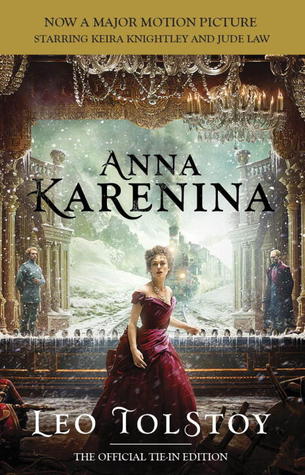
Book Review: Anna Karenina by Leo Tolstoy

Anna Karenina is one of those classic stories that you would think really needs no introduction - at least that's what I thought before I read it. I've seen 2 different versions of the film of this book, the one with Vivien Leigh and the ones with Keira Knightley, and neither of them was a very good representation of the actual story.

Anna Karenin is the wife of a well known political figure in St. Petersburg, Russia. She leads a normal life for a woman of her position in the late 1800s, and she has an 8 year old son. One day when visiting her brother in Moscow, her life changes. She was in Moscow to convince her sister-in-law not to divorce her two-timing husband when she meets the man her sister-in-law's younger sister is in love with, Count Vronsky. Vronsky and Anna have an immediate and unexplainable attraction that they can never shake. They begin an affair in spite of Anna's marriage. Anna feels extremely guilty for what she's done, but can't separate herself from Vronsky. After much turmoil, the affair eventually causes Anna to lose her place in society and drives her into such a deep depression that she throws herself in front of an oncoming train.

That is the story that most people think of when anyone mentions Anna Karenina - inexplicable deep love and personal torment. This story is of course what the book is named for, but not what I would identify as the main point. The story is not just about Anna and Vronsky (gasp!) - the story is sort of split in two and shared between time to describe Anna's life as well as Constantine Levin, the man who is in love with Anna's' sister-in-law's younger sister, Kitty. Kitty is head over heels for Vronsky and all is going well until Anna shows up and unintentionally steals him away from her. Kitty is devastated. She had just refused an offer of marriage from Levin in hopes that Vronsky will ask her only to have him toss her to the side like nothing. Vronsky never feels remorse for this. He's a very self-centered man who is only out to please himself. Kitty and Levin then break for a while, understandably. Levin becomes very deep in work at his farm (in spite of his social status, he enjoys the manual labor of farming), and just goes on with life - but he never really forgets Kitty. Kitty grows up quite a bit, and quite a while later (I believe it's over a year later), she and Levin meet again and become engaged and get married.

It is safe to say that the story of Levin is to serve as a contrast to the story of Anna. If Anna's life is about throwing aside everything in the name of love, Levin's' story is more along the lines of good things come to those who wait. Both stories have one chief concern: the pursuit of happiness. Levin is a very good (and very stereotypically Russian) man, and he not only loves Kitty deeply, but he also devotes a good deal of his life to being a better person. He is on the quest for the meaning of life, and while he doesn't really learn "the meaning", he realizes a great deal about man's relation to God and why it's important. Levin is a very level headed and realistic person, while Anna is wrapped up in being what she believes Vronsky wants her to be, which aids her paranoia that he will up and leave her. She is so codependent it's crazy. She is obsessed with being attractive at all times, spends time reading books on subjects she knows Vronsky is interested in, and can't stand to be separated from Vronsky even for an evening. This mental state would drive anyone nuts, and eventually Anna decides that Vronsky's life would be greatly improved if she wasn't in it, so she kills herself. Levin, on the other hand, achieves healthy and sustainable happiness. He works for what he has and appreciates it, never taking any of it for granted and always striving to achieve more.

I realize this is a very small snippet of what the story actually conveys - it was an incredibly long book. I really enjoyed the entire story though. Not only is it a story about love and happiness, it's also a great look into Russian history in the time that lead to the crazy events that would change Russia forever. It's very interesting to get into the minds of those who lived in that time, and it really does make the Russian revolution in 1912 make much more sense. This was an excellently written book as well - I was quickly struck with how modern the writing style is in spite of it publication date. I can completely understand why this book has been cherished for its entire existence and it is really worth adding to your list. I give this book 5 out of 5 stars.